Archive | PBM / Pharmacy RSS feed for this section

AIS Webinar Regarding Drug Coupons

Health Plans vs. Drug Coupons:

Tactics to Combat Brand-Name Drug Promotions

AIS Webinar: Wednesday, July 13, 2011

When faced with the loss of patent protection, brand-name drug manufacturers are increasingly launching promotional programs to maintain market share of their blockbuster drugs and improve brand loyalty. These promotions, including copay coupons, discount cards and rebates, can pose headaches for PBMs and health plans. But there are strategies plans can adopt — including zero-dollar copays, over-the-counter initiatives and utilization management strategies — to reduce the impact on utilization and move more enrollees to low-cost generic alternatives. Discover the pros and cons of various strategies.

Pharmacy Kickoff At #RESULTS2011

I’m currently presenting at our client event (see twitter hashtag #results2011 for real-time comments). My presentation is an extension of my white paper on the future of the PBM / pharmacy industry along with a blend of data from our annual client survey and Silverlink Communications best practices with a focus on our work around medication adherence. It also builds on my thoughts from NCPDP that I shared late last year.

Here are a few of the points I touch on:

  • Avoiding being commoditized by adding value
  • Keys to success with a focus on:
    • Evidence-based approaches
    • Consumer engagement
    • Patient experience
    • Cross-channel coordination
  • Adherence and other priorities
  • How to use SMS to drive self-service
  • An approach to condition management in hypertension and diabetes
  • Focus on the “un-engaged” but don’t forget about the engaged consumers
  • Case studies and research around adherence
  • Timing and sequencing of direct mail, automated calls, and e-mail
  • Measuring “trust”

Here’s a teaser of some of the slides I’m presenting:

Walmart: Good or Bad for the PBMs

I think this is a question many of my PBM friends would like to know. Fortunately, a few of the Walmart people that read my blog and are part of their Health and Wellness group agreed to sit down and talk about their strategy.

Let’s start with setting some background:

  • Walmart was the first to introduce the concept of $4 generics which originally caught the market off guard and has created lower generic costs and free antibiotic programs at several pharmacies. [I would also argue that it highlighted the fact that generic copays were getting too high.]
  • Walmart was the first to work directly as a pharmacy to create a limited network contract direct with an employer (Caterpillar).
  • Walmart has partnered with Humana on a limited network offering for Medicare.
  • Walmart came out with a direct to consumer mail order pharmacy offering.

If you follow the industry, you know that all of these things were potential game changers (if they’ve worked).

This creates some tension:

  • Is Walmart simply a catalyst for change in the healthcare space?
  • Does Walmart (pharmacy) want to disintermediate the PBM?
  • Is Walmart able to make money where others can’t?
  • Does Walmart get more foot traffic such that pharmacy can be a loss leader?

Here is the Q&A [interpretive not literal] from my dialogue with Marcus Osborne (Sr. Director, Business Development, Healthcare, Walmart) and Tom Hill (Director, Health Services Development, Walmart).

What is Walmart’s Health & Wellness strategy?
Walmart wants to help consumers “save money and live better”. That is our DNA and our fundamental approach to the market. Pharmacy has presented a unique challenge since consumers often have the same copay regardless of which pharmacy they went to. Even when it’s a percentage copay, the savings differential might not be much to the consumer. Walmart was disconnected from the consumer in the traditional pharmacy pricing approach. That has driven us to look at unique ways that we can create savings.

How does Walmart decide what “offerings” to bring to market?
Walmart looks at ideas that focus on our EDLP (Everyday Low Price) concept and leverage our supply chain efficiencies. We are constantly looking at non-store operational opportunities to work directly with key companies. We currently have over 20 direct relationships with managed care companies and PBMs where we are working with them to drive down consumer costs in the pharmacy and broader healthcare area.

Obviously healthcare is bigger than pharmacy. What other things are you doing to drive healthy eating, management of critical conditions, or other programs? We’re constantly looking at what’s needed in the healthcare sector and where to invest. We focus on our two key advantages:

  • Willing to trade profit for volume
  • Value of the total “box” [store]

A good example is the work we’ve done around “Healthy Mom Healthy Baby” in Medicaid. We looked at the issues of high pre-term labor and the high rates of injury post-birth. We felt like we had a moral and cost imperative to take action. As part of this, we worked with several managed care groups to redefine the entire process and look at our unique assets. Our solution includes:

  • Free pregnancy tests
  • Free pre-natal vitamins
  • Rewards for free diapers and other supplies tied to physician visits and other health activities
  • Free car seats
  • Leveraging our physicians and clinics

[I was impressed…this was a broad solution that looked at a lot of their assets.] We’ve also created several diabetic specific solutions; a smoking cessation program with Healthways; weight management programs; and women’s and men’s health programs. The focus is on payers that are at risk for their healthcare spending with more to come from clinics.

Will Walmart become a PBM?
No. We’re not looking to go into the PBM market. We’re supply chain experts. We see value in the PBM model. [We talked a little about the fact that “you are what your profits say you are” meaning that the PBMs have painted themselves into a profit corner where their profit comes from generics at mail order so any threat to that is a challenge.]

If the Caterpillar model was so successful, why haven’t others adopted it?
The reality is that over 400 employers have contracted directly with Walmart for a limited network model similar to Caterpillar. They are all seeing significant savings.

Does Walmart see the market through “different glasses” than others?
No. We still want to have the pharmacy be a profit center. We’re not looking to bottom out the market, but we are willing to trade lower profits per transaction in return for more market share. At Walmart, it’s not about maximizing revenue/Rx or profit/Rx…it’s about total revenue and total profitability. [A very different strategy than other CFOs which would say you can’t expect volume to make up for lower profitability.] Obviously, we also have the opportunity to get non-pharmacy sales associated with food traffic. One thing that may be is different is the fact that we believe scale should drive down costs. In pharmacy, the biggest players are always trying to command a premium. We think it should be the other way around. We also have been able to get our cost-to-fill to be the same at retail and mail so we’ve become channel ambivalent.

Have these programs improved market share in any significant ways? You have to look at the programs separately, but overall we’ve seen our market share increase from 6% overall [when the $4 generic program launched] to 10% now. The network design strategy has had great success. We look at three types of programs:

  • Incentive based networks
    (Caterpillar 1.0) where all the pharmacies are in the network, but there is a lower copay to go to certain pharmacies. If only 15% of pharmacies are preferred, their market share doubles. If Walmart is the only preferred pharmacy, their market share goes up 4x.
  • Limited networks where some pharmacies are removed from the network. If you drop the network significantly, they’ve seen their share go up 2-3x.
  • Limited networks with preferred pharmacies where you some pharmacies are removed from the network, but within the remaining pharmacies, there are still incentives to go to certain stores (Caterpillar 2.0). In these cases, they’ve seen their share go up 10x.

The $4 generics program has helped increase market share by an estimated 150 basis points. In many cases, companies that initially jumped to offer similar programs have dropped them. They couldn’t sustain them.

The Medicare program with Humana has been very significant and successful [as demonstrated by Humana’s huge jump in Medicare lives].

The direct-to-consumer (DTC) programs for mail have been pretty limited and haven’t had a huge impact, but they’ve been offered in markets where we have no stores (e.g., Detroit and NY) and therefore almost no share to begin with so any share is a gain.

People complain about the pharmacy location within the store. Would you ever consider a direct access point to the pharmacy which didn’t involve going through the entire store? This is a very hot topic. We did a lot of research about store design and what goods should be located next to each other, but in the end, we’re considering moving the pharmacy closer to the front entrance. Right now, 25% of the stores have a drive-through pharmacy which gets utilized at a very high rate. But, this does lose the pharmacist face-to-face benefit. [At the end of the conversation, my take is that they are looking at lots of scenarios here and trying to figure out the balance of convenience to the pharmacy only consumer and how to optimize the entire footprint.]

The partnership with Humana really seemed to help them grow their Medicare lives this year. How did this come about? We both were looking for new solutions to leverage the fact that scale matters and how to operate within the CMS parameters. We felt like there was an opportunity to do something different and began speaking with plans about some limited network ideas. We know that Walmart is over-indexed in the 65+ category based on store visits per week. Based on that, we were looking at what we could do to offer them more value as compared with our traditional, core customer of 35-50 year old females. Through a series of conversations, the partnership was born. We’re very happy with the relationship and believe they are also.

Limited networks have been around for a long-time with limited adoption. Do you think their time has finally come? What has changed? They have been around, but historically the networks weren’t limited enough to create enough savings to overcome the “costs” of disruption to the payer. Based on our experience at Caterpillar, we believe that you will see a transitional period where companies first move to incentivized networks and then 1-2 years later move to limited networks. [Something I would compare to the transitions which have happened in formulary over time.] The one area where we do see limited networks happening more rapidly is in the area of Managed Medicaid. [This plays into the focus of PCMA and others on the PBM opportunity around Managed Medicaid.]

It was a great discussion. I learned a lot. They allowed me to ask them a lot of questions about their programs and approach that honestly had led to some skepticism in the past. It sounds like they’ve brought together a great team with a broad vision of what they can do in pharmacy and in health and wellness overall. It has gotten my mind thinking about ideas, and I look forward to learning more.

[BTW – You can sign up to get posts like this e-mailed to you whenever I write them.  A registration link is in the right hand column.]

PBM Mobile Applications – CVS, Humana, Medco, Express, Catalyst, Prescription Solutions

This week, Medco released their mobile application that they’ve been working with Verizon on.  Not a big secret in my mind since I’ve been hearing about it since last Fall.  I’ve talked about CVS Caremark’s application (CVS mobile), Humana’s application, and CatalystRx’s application.  So, this made me wonder why I hadn’t heard about one from Express Scripts.  It seems unlikely that they wouldn’t have one.

There doesn’t seem to have been a lot of fanfare, but they launched one in March.  Here’s a quick summary of it:

The new Express Rx mobile app works across multiple platforms, and is now available for a free download at both the Apple iPhone App Store and at the Android Market (simply search ‘Express Rx’).  In addition, members using a Blackberry or other smartphone device with web browsing capability can access our mobile optimized website at http://m.esrx.com.

With our new mobile app and mobile optimized website, Express Scripts members will be able to securely access the following functions:

  • Start Home Delivery – transfer available maintenance medications to the Express Scripts Pharmacy
  • Order Refills – select and schedule prescriptions to be refilled from the Express Scripts Pharmacy
  • Check Order Status – check to see if an Express Scripts Pharmacy order has shipped, the ship date and by what method
  • Find a Pharmacy – locate a nearby retail pharmacy using the GPS technology built into a smartphone
  • Drug Information – access Drug Digest database to look up drug information, common uses and possible side effects

The app consists of three features: My Rx Choices, which delivers on-demand, personalized out-of-pocket costs, interactions and other information for any prescription drug; My Medicine Cabinet, which allows patients to view the medications they’re on, including prescription and over-the-counter drugs, and set reminders for themselves; and Prescription ID Card, which allows convenient access to a member’s prescription drug card.

Of course, Walgreens also has a mobile application as does Walmart.  Neither of them are PBMs, but they are both critical players in the pharmacy space.
Next on my list to check out is Prescription Solutions.  They also have a mobile application which does:
  • Refill mail service pharmacy prescriptions
  • View your prescription history
  • Set up text message medication reminders
  • Check the status of and track orders
  • Locate a pharmacy by ZIP Code
  • Search your formulary by generic or brand name drug, status, or class
As one might expect, mobile web or mobile apps are quickly becoming the norm.  The key to look at is what is the functionality.  Is it simply putting their websites on a phone or are they developing other technologies that take advantage of the mobile environment (e.g., location based services or enhanced reality).  I’ll share some thoughts on those in another post.

Medicare Lives By Plan

Medicare has been a big area of focus for a lot of plans and subsequently for a lot of PBMs who manage the PDP plans.  The biggest area of discussion is around the STAR Ratings.  And, that’s important because if you look at data from the WilsonRx reports there is certainly a correlation between PBM satisfaction and health plan satisfaction. 

So, the question is who has the Medicare lives today and who are the big winners YTD (source – CMS and Citi Investment Research and Analysis – summarized by Carl McDonald and team at Citi):

For a detailed breakout of PDP lives and the huge win by Humana going into 2011, I would suggest reading Adam Fein’s post from a few months ago on DrugChannels

And…if you haven’t been following it, it looks like Medicaid is the green field that everyone is eyeing.  The savings from managed Medicaid are getting discussed in multiple states especially around pharmacy.  I just had a call today where the executive predicted that managed Medicaid would be the feather that finally broke the back to get limited networks more traction (interesting!).

MD Adherence Campaign – Uphill Battle

Based on the feedback I got on my post on KevinMD about paying MDs for adherence and other research out there, it would seem that this new campaign called Script Your Future is facing a significant uphill battle.  While I completely agree with the concept of pushing adherence discussions to the point-of-prescribing, the question is whether this will happen during the physician encounter.  The other challenge is whether patients realize that they are non-adherence.  Prior studies have indicated a lack of awareness around how non-adherent they are.

CVS Caremark Pilots New ePA Technology

CVS Caremark announced earlier this week that they were launching a pilot to improve the prior authorization process. They are partnering with Navinet, Allscripts, and Surescripts to do this. This should be an interesting pilot to monitor. They plan to share the transactions and the results with the market to hopefully drive industry standards.

“CVS Caremark understands the opportunities that innovations such as electronic prior authorization provide to prescribers and patients looking to embrace a more efficient and effective way to share critical prescribing information,” said Troyen A. Brennan, M.D., M.P.H., chief medical officer of CVS Caremark. “The prior authorization process is currently evolving to keep pace as prescribers transition towards electronic prescribing and electronic patient records to better manage their patients’ pharmacy care. This pilot is an important step toward demonstrating how the industry can integrate ePA with e-prescribing to streamline and speed up processing of prior authorizations to ensure that members have quick access to care that is medically appropriate and cost-effective.”

How Many Formulary Tiers Is Enough?

Just this week, I’ve seen two things about creating more formulary tiers.  One was talking about splitting generics into two tiers.  The other mentioned that CMS said a sixth tier could be used in certain circumstances.  It sounds like this could get out of control.

Will we end up with something like this:

  • Low-cost generics (i.e., $4)
  • Generics
  • Formulary brands (non-specialty)
  • Non-formulary brands (non-specialty)
  • Lifestyle drugs
  • Specialty biosimilars
  • Formulary specialty drugs
  • Non-formulary specialty drugs

It seems reasonable that we could end up with 8 tiers!  That is a patient nightmare.  It’s difficult enough to understand today.  Maybe, I’ll finally become a believer in a percentage copay model with just two or three tiers of cost share with maximums.

Summary Of Big 3 PBM Drug Trend Numbers

All of the big 3 PBMs have now reported their drug trend for 2010.  How do they compare?  [acknowledging that methodologies are different]

  1. CVS Caremark = 2.4% (0.8% without specialty)
  2. Express Scripts = 3.6% (1.4% without specialty)
  3. Medco = 3.7% (1.1% without specialty)

Now, I’ll reiterate my points from the past which are:

The Medco Drug Trend Report Is Out

Medco just released their Drug Trend Report this morning. For the second year, I got invited to their press call, but unfortunately, I had to miss the call. I sent in four questions:

  1. ADHD trend continues to increase.  With the new DSM-5 proposal, it looks like there will be more teens and adults diagnosed with adult ADD.  Do you see this accelerating the trend in this category even more?
  2. As generics get closer to 80%, the remaining brand drugs will have to try new strategies to sustain utilization.  One of the growing tactics is copay coupons or cards.  Do you see this as an issue?  Are there tactics that you intend to use to address these through POS programs or other programs?
  3. You talk about clients spending less PMPM on members age 0-18 which seems to run counter to the focus from last year on more, younger patients using maintenance drugs.  What do you attribute that drop in spending to?
  4. You bring up biologics.  It’s unlikely that biologics will generate large price drops as we’ve seen from generics.  What do you estimate will be the savings associated with biologics and will we see therapeutic interchange programs or will you manage the biologics more like a step therapy program?


Here are a few of the key highlights from the report:

  • Overall drug trend in 2010 remained low at 3.7%.
  • 2010 spending on specialty drugs accounted for 16.3% of plan costs but was responsible for a remarkable 70.1% of drug trend.
  • At 16.7%, diabetes was the therapeutic category that contributed most to trend.
  • The cost of cancer care is projected to rise from $124.6 billion to as much as $207 billion by 2020.

The report has a large focus on specialty which is really where the industry is going. I’ll dig into the report when I have some additional time.

Why Aren’t We More Focused On Rx-OTC Interactions?

The pharmacy system in the US does a good job of catching drug-drug interactions at the POS (point-of-sale) when the claims are all processed by a PBM or all the drugs are filled within the same pharmacy.  But, with 68% of adults taking both a prescription drug and either an OTC (over-the-counter) or dietary supplement (per JAMA Jan 2009), do we need a broader safety net to catch all those?

I was looking at an old Medco deck from last year.  It estimated that there are 30B combinations if you look at 80,000 prescription doses, 300,000 OTC products, and 75,000 dietary supplements. 

Of course, when you go to the pharmacy, you fill out some basic information.  You do the same at your physician.  But, how often are those updated?  Do you have an easy way to register new products you’re trying? 

On the flipside, the question is what percentage of these 30B combinations are important versus just noise?

There are some significant examples here…

For example, Proton Pump Inhibitors (PPIs) increase the risk of major cardiovascular events by more than 50% for patients taking Plavix, but you can now buy several PPIs over-the-counter.  How would the pharmacy or PBM know?

Your Refill Logic Has To Be Dynamic

I signed up for an auto-refill program recently.  It quickly made me realize how stockpiling happens.  (Stockpiling is where a patient ends up with a large supply of their medication over time…typically due to refilling too soon.)

Imagine the following:

  • I get a 90-day supply of a medication.
  • At day 75, I get a refill of the medication.  (I have 105 days left at this point.)
  • 75 days later, I get my next refill.  (I now have 120 days left at this point.)
  • 75 days later, I get my next refill.  (I now have 135 days left at this point.)
The problem here is what I would call “static refill logic”.  The auto-refill program is triggered to fill the drug 75 days after it was last filled.
What is needed is “dynamic refill logic” which calculated days supply on hand.  This isn’t easy, but it makes a lot of sense.  The risk (if I’m a mail pharmacy) is that without this, I get gaps-in-care and/or create a short-term retention issue.
Imagine the following:
  • You ask me to refill, but I have 30 days on hand so I say no.
  • Now I forget to refill on time and I have a choice – (a) skip my medication for a few days or (b) go back to retail.  Neither is ideal for the mail pharmacy.
BUT, all of this could have been fixed if the logic was dynamic and they called to confirm my refill when I had just a few weeks left (i.e., enough to be thinking about refilling but also enough to have time to get it shipped to me).

Are Limited Distribution Deals Good For Patients?

People with complex conditions such as RA, cancer, hemophilia, MS, HepC, and other diseases that are treated with specialty drugs (often injectibles) are subject to several unique complexities in filling their prescriptions:

  • Potentially significant cost burdens
  • Limited locations at which to fill their medications
  • Prior authorization requirements
  • Scheduling complexities for delivery or home infusion or coordination with their physician’s office
But, there can also be another complexity called “limited distribution” which is where the manufacturer has only allowed the drug to be filled by a select list of pharmacies.  So, imagine the following situation:
  • You are a patient with multiple co-morbidities.
  • You have several chronic oral medications along with several specialty drugs that you have to fill.
  • You fill one of your chronic medications at retail since you forgot to refill it in time one month at mail and just haven’t gone back since the saving is minimal (as it’s a generic).
  • You have two other oral, chronic medications that you fill at mail order.
  • You fill two of your specialty medications at the preferred specialty pharmacy under your benefit (i.e., limited network).
  • You fill your last two specialty medications at two other specialty pharmacies since both of them are limited distribution products neither of which have contracts with the preferred specialty pharmacy in your network.
You now have to coordinate between five pharmacies.  What ever happened to people worrying about poly-pharmacy?  Is it an issue?
Now, this is important since complexity of therapy (# of drugs and # of pharmacies) appears to be a key factor influencing likelihood of adherence, but I never hear anyone worry about it anymore.
So, I ask…are the limited distribution deals which limit access to a specific specialty drug an undo burden on the patient or is the value of specialized care and monitoring more valuable to the patient?

No Plans To Split Up CVS Caremark

I’m glad to see Larry Merlo come out in the CVS Caremark earnings call and talk about them not splitting up the company (see Adam Fein’s post).  I’ve been talking about this for a while (see old post).  I think that they have the right combination of assets to do something really significant. 

They followed that up with a press release this morning:

Speaking at the Annual Meeting of Stockholders for the first time as CVS Caremark CEO, Merlo said, “The fact is no one else can match our combination of assets — a leading PBM, one of the largest retail pharmacy chains, a leading specialty pharmacy, a growing Medicare Part D business, and the largest and fastest-growing network of retail health clinics. CVS Caremark is using these combined assets to develop and implement innovative programs and offerings, such as Pharmacy Advisor and Maintenance Choice, which should drive long term value for shareholders.”

The rumors and stories of increased value of splitting the company up were getting to be too much noise.  Employees, clients, customers, investors, and everyone else needed them to come out and set the record straight.  Of course, anything can be debated and changed over time, but you need a clear direction.  I’m glad to see them stand up and reiterate their strategy and vision around creating a unique set of assets to derive unique value. 

[Disclosure: As I’ve shared before, CVS Caremark stock is one of a few individual stocks that I own.]

How To Improve Use Of A Preferred Pharmacy

One of the key questions from PBMs, pharmacies, specialty pharmacies, and payers is…
 

How can we drive utilization of a preferred channel (retail, mail order, specialty)?

 
I’ve worked on 15+ different “retail-to-mail” type programs (or even just 30-day to 90-day).  They typically follow a pretty standard profile:
  • Identify who to target
    • Plan design (does the member save?  the payer?)
    • Maintenance drugs
    • Categories (is titration an issue?)
  • Score individuals for prioritized outreach
    • Likelihood to convert (drug, prior experience, costs)
  • Create personalized messaging
    • What’s In It For Me (WIIFM) – cost, convenience
  • Create business rules
    • What’s the best channel?
    • What’s the best time to call or e-mail? 
  • Engage people and quickly transfer them to an agent who can answer their questions
    • How do I get started?
    • How much will I save?
    • Why should I do this?
    • Who are you?
  • Make the process easy…call or fax their provider and get a new prescription for the new pharmacy
  • Implement a process of continuous improvement
    • What works?
    • What could be better?
    • Are their differences within certain sub-segments?
    • How can I test and validate my assumptions?

At the end of the day, this approach can also be used for formulary support and many other programs.  The important things are:

  1. Engage the consumer in a dialogue about their options
  2. Be clear about the value of change
  3. Make the process easy
  4. Answer their questions

15 Things You Should Know About Prescription Non-Adherence

One question I frequently get is “what should I know about adherence”. This is then followed by “so what should I do about it”.

Here’s my starter list of what you need to understand about medication adherence.

  1. It’s a $290B problem.
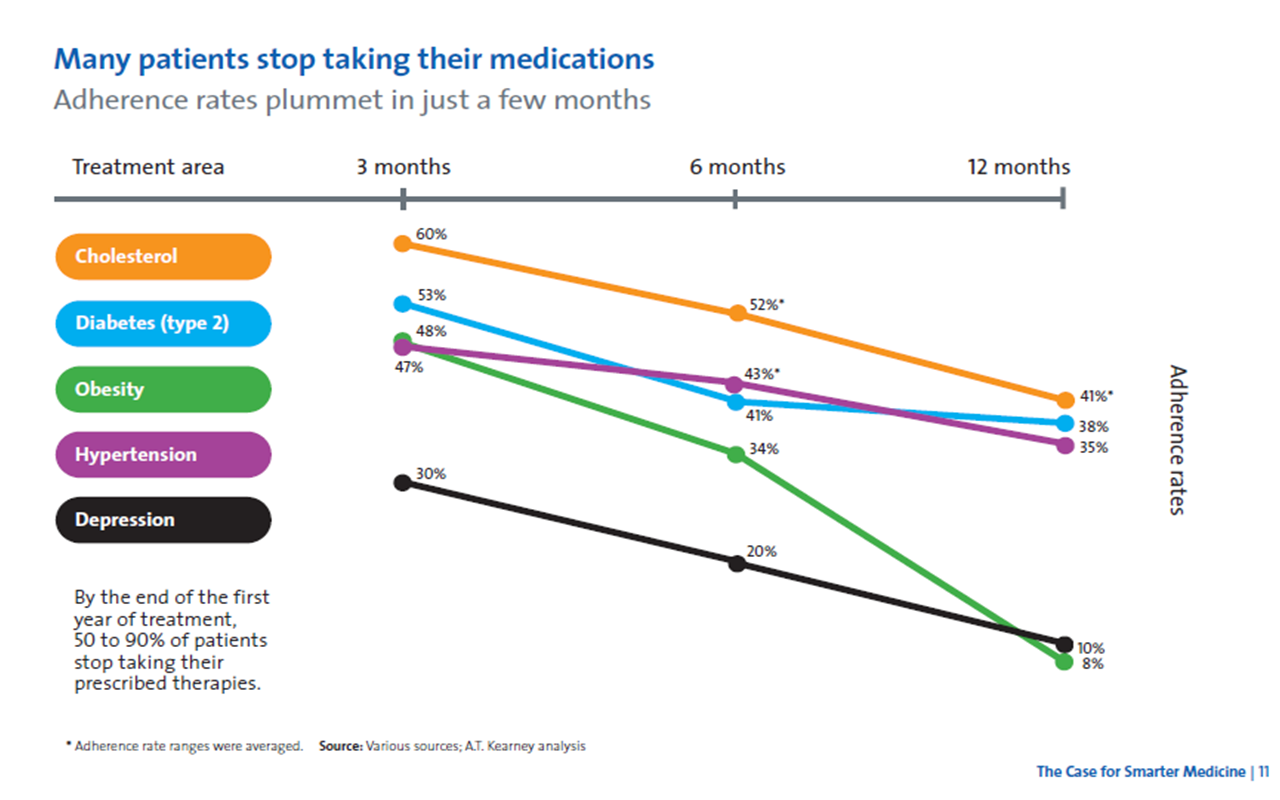
  2. Patients fall off therapy quickly.
  3. There are a lot of reasons for non-adherence…it’s not just about reducing out of pocket spend. AND, to make it more complex, there are variations by gender, culture, medication, condition, trust, copay levels, etc.
  4. There are lots of predictors of non-adherence (old study, Express Scripts, Merck tool), but generally the best predictor is past behavior.
  5. Interventions can improve adherence (CVS Caremark study, Express Scripts study, Silverlink data). BUT, physicians generally don’t see non-adherence as an issue they can address. (see also White Coat adherence)
  6. Patients don’t think they’re non-adherent (see “Rx Adherence Hits The Ignorance Wall” by Forrester that says only 8% of people think they are regularly non-adherent).
  7. Adherence reduces total healthcare costs (CVS Caremark study, Sokol study).
  8. Communications matter (misperceptions, physician-patient gap, health literacy, what physicians tell patients).
  9. There are lots of cool technologies that will work for different people (talking bottles, monitoring devices, iPhone reminders, websites, pill boxes). BUT, improved labeling and bottle design may not be the answer (analysis of Target improvements).
  10. Starting on generics (or lower cost drugs) improves the probability of adherence.
  11. Pharmacist involvement is key and impactful (CVS Caremark study, Ashville).
  12. 90-day prescriptions lead to better medication possession ratio (Walgreens study, CVS Caremark study, Kaiser study, Express Scripts study).
  13. Complexity of therapy (e.g., number of prescriptions) increases the likelihood for non-adherence.
  14. Electronic prescribing gives us new visibility into primary adherence and should also create opportunities to improve this issue.
  15. It’s an area where everyone wins and there’s lots of research…but there’s no silver bullet.

Should You Pay Physicians For Medication Adherence?

I’d love to hear some physician perspectives on this. It’s a question that comes up every once in a while.

Let’s start with a few facts:

The question of course is what to do about that. Most of the programs focus on consumer or patient interventions.

  • Refill reminders
  • Gaps-in-care
  • Off-therapy reminders
  • Auto-refill programs
  • POS consultations by the pharmacist

But, interestingly, I’ve seen a few other studies recently that show that prescription programs targeting physicians can influence behavior (example here). I’ve also heard a few companies talk about paying physicians to keep patients adherent.

There are a few arguments that happen here:

  • Should the physician play a role in adherence?
  • Does the physician know if a patient is adherent? Should they get this data? From whom?
  • If the physician asks the patient, will they tell them to truth or will it simply be a case of “white coat” adherence?
  • Should this be a performance metric in a pay-for-performance environment?
  • Will PCMHs and ACOs structures change this and make adherence a critical issue for discussion between the patient and physician?

In general, I think most people believe that physicians (as indicated in studies like this one) don’t see prescription adherence as a big issue that they can or should influence. Is that true? Would “incentives” change that?

Of course, the debate isn’t limited to paying physicians as multiple companies are paying consumers to be adherent. Here’s a post from last year from another blogger called “Paying Patients To Take Their Medications Is Stupid” which is similar to one of my posts from last year.

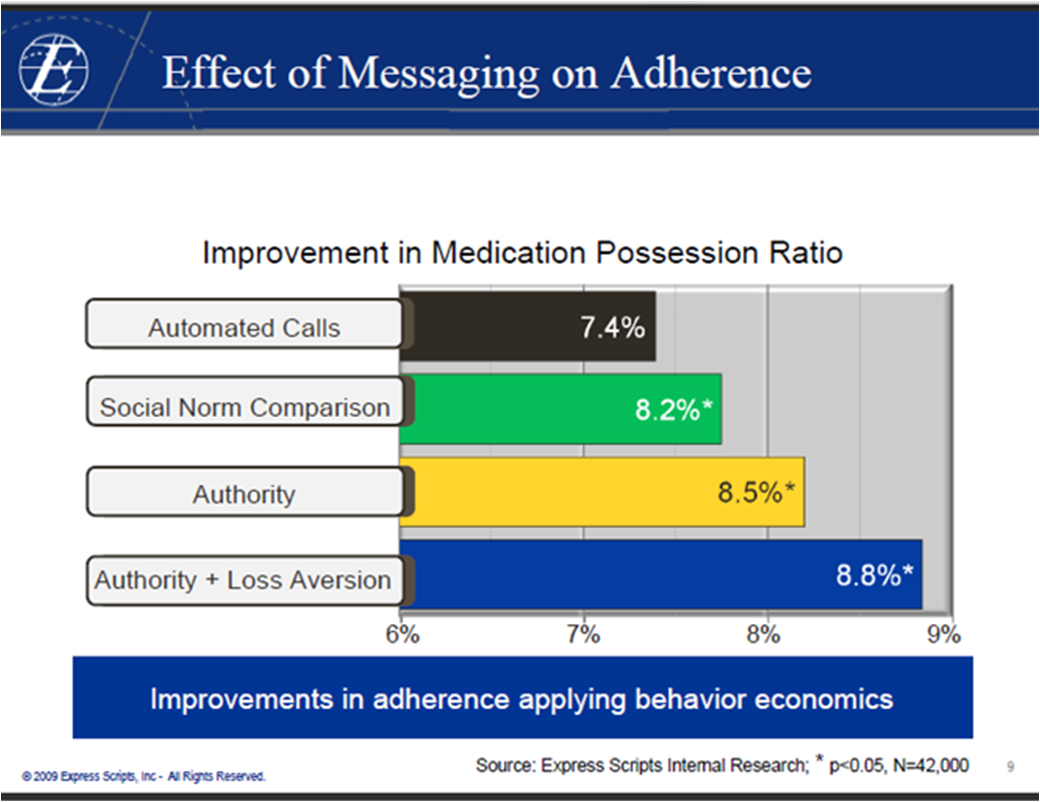
Automated Calls And Messaging Impact MPR

One of the big questions I’m often asked is how automated calls can impact Medication Possession Ratio (MPR).  This is both a technology question, but also a messaging question.  I was happy when I recalled this image from an Express Scripts investor presentation.

Looking Forward To The Silverlink Client Event – RESULTS2011

One of my favorite events every year is the Silverlink Communications client event in May in Boston.  Our marketing team does a great job of pulling together a mix of clients and external speakers to really motivate and challenge the audience.  It’s not much of a sales event, but it does a great job of pushing a lot of key topics for discussion.  (See prior posts – last year’s event, notes from RESULTS2010, and notes from RESULTS2009.)

This event was one of the things that originally convinced me to join Silverlink back in 2007.  Sitting and talking with clients about their experiences with the company, their shared passion for results and outcomes, and their interest in collaborating to improve outcomes for consumers was motivating.

This year should be no different.  This year’s theme is – “Seeing Healthcare Through The Eyes Of The Consumer“.  There are presentations on sustaining engagement, obesity, diabetes, health literacy, social media in healthcare, adherence, loyalty and retention, health reform, STAR, HEDIS, and many other topics.

Some of the speakers include:

  1. Dr. Atul Gawande (Harvard, The New Yorker, Author)
  2. Thomas Goetz (WIRED Magazine)
  3. Dan Buettner (Author, The Blue Zones)
  4. Mark Merritt (PCMA)
  5. Dr. Will Shrank (Harvard)
  6. Jim Wilson (WilsonRx)
And many other executives from across healthcare.
It promises to be another banner event.  I’ll share some summarizes as time allows via Twitter and eventually after the event.
I guess with attendance maxed out and the hotel sold out it’s time for me to buckle down and work on my presentation!

Should You Worry About The Drug Dealer Or Your Prescriptions?

Drug abuse has been an issue for years. I think the advertisement on TV that has a drug dealer talking about getting less calls makes a point that I hear more and more – patients selling their prescription drugs to make money.  Some of this is intentional, but some of this is opportunistic.  You don’t have to go far to hear about seniors being arrested for selling their prescriptions to make money to pay bills (recent article). 

And, recreational use or overuse of controlled substances is a growing problem.

“Unintentional drug overdose is a growing epidemic in the U.S. and is now the leading cause of injury death in 17 states,” Center for Disease Control Director Dr. Thomas Frieden was quoted as saying in a statement from the White House’s Office of National Drug Control Policy. (source)

There are lots of stories about kids using prescriptions drugs for ADHD recreationally to help them study.  There has probably been a switch over the years from stealing liquor from parents liquor cabinet to borrowing a few of their prescriptions (see story on 5 drugs kids steal most often).  It’s a scary thought.  (Or, this article says that 20% of the time adults are asking kids if they can use their ADHD medicine.)

The Partnership For a Drug-Free America‘s latest survey has 61 percent of teens reporting prescription drugs are easier to get than illegal drugs, up significantly from 56 percent in 2005. And 41 percent of teens mistakenly believe abuse of medicines is less dangerous than abuse of illegal street drugs.

Does Changing Drugs Erode Trust

One of the big tools that PBMs use to manage drug trend and improve generic fill rate is step therapy. Another one is therapeutic substitution. Both of them rely upon the patient to change medications.

Based on a study published last year, one of the issues identified for adherence was the patient’s belief or trust in their physician. Switching medications (I.e., trial and error) was viewed as eroding that trust.

It creates an interesting question about these tools. Do they erode trust? Do they impact adherence? I think the standard perception would be that lower cost medications would improve adherence. I know research by Shrank has shown that starting on generics leads to better MPR. Is that true for patients that start on a brand and move to a generic?

On the other hand, the research points to the need for the physician to explain to the patient about the plan for care which might include “trial and error”. Certainly personalized medicine may change this need in the long-term, but in the interim, does this create a chance for PBMs to support MDs in a new way by providing this context to the patient?

More questions here than anwers, but an interesting topic.

Patient Educ Couns. 2010 Jul 30.
“Practicing medicine”: Patient perceptions of physician communication and the process of prescription.
Ledford CJ, Villagran MM, Kreps GL, Zhao X, McHorney C, Weathers M, Keefe B.
George Mason University, Fairfax, VA, USA.

Abstract
OBJECTIVE: This study explores patient perceptions of physician communication regarding prescription medications and develops a theory of the effects of perceived physician communication on the patient decision-making process of medication taking.

METHODS: Using a grounded theory approach, this study systematically analyzed patient narratives of communication with physicians regarding prescription medications and the patient’s resulting medication taking and adherence behavior.

RESULTS: Participants described concern about side effects, lack of perceived need for medications, and healthcare system factors as barriers to medication adherence. Overall, participants seemed to assess the utility of communication about these issues based on their perceptions of their physician as the source of the message.

CONCLUSION: The theory generated here includes patient assessments of their physician’s credibility (trustworthiness and expertise) as a critical influence in how chronically-ill patients process information about the need for prescribed therapy. Trial and error to find appropriate medications seemed to deteriorate patients’ perceptions of their physicians’ credibility.

PRACTICE IMPLICATIONS: A practical application of this theory is the recommendation for physicians to increase perceived expertise by clearly outlining treatment processes at the outset of treatment, presenting efficacy and timeline expectations for finding appropriate medications.

More Generics = Slower Rx Cost Growth

I’m not really sure if this surprises anyone, but it seems to be making news. Generics drug prices increase much slower than brand drug prices, and with the huge increase in GFR over the past 5-10 years, trend has slowed down.

The total 2010 spend on prescriptions was $307B. This was up just 2.3% from 2009.

The interesting point in this recent data from IMS is that the utilization growth rate for Rxs has slowed to historically low levels also.

One might attribute some of this to saturation although I think we’re far from that. Others might see a backlash against medicine and a search for more natural remedies. But, the key fact that they talk about is the drop in MD visits which can certainly be correlated to the economy. In 2010, there were 1.54B office visits…a decline of 4.2%.

The research also said

“Pharmacies filled 0.5 percent fewer prescriptions in 2010 than in 2009 for pills, capsules and nasal spray medications — about 60 percent of total spending on medications. For medicines that are injected or infused, total volume rose even less, just 0.2 percent.”

Could CVS Caremark Become A Kaiser?

I know the popular opinion is to talk about CVS Caremark splitting up.  Let me go radically in the other extreme. 

I think everyone has an appreciation for what Kaiser has created – insurer, provider, pharmacy, …  They’ve created an integrated system with impressive outcomes, passionate consumers, and a connected technology backbone.  There are a few other organizations that have had regional success doing the same – HealthPartners, Geisinger, … 

The question I would have is who is in the best position to build themselves into an integrated system.  The two companies that jump out at you are United Healthcare and CVS Caremark.  Of course, neither of them have the provider (aka hospital) assets. 

But, I think the point here is that most people I talk to agree that an integrated model is the right model “on paper”.  It can (in theory) offer the best patient experience.  It can drive the best integrated data.  It can coordinate across business lines to accomplish the best outcomes. 

So, it makes me wonder why we let Wall Street dictate the strategy here.  In many cases, structural changes take time.  If building an integrated model is the right concept, why isn’t the talk about CVS Caremark buying a health plan and subsequently jumping into the provider space with ACO models?  Why isn’t the discussion about United Healthcare buying up hospitals and physician groups?

Maybe I’m just trying to present a different scenario or maybe I have rose-colored glasses on, but I think it’s an interesting question to ponder.

(Note: As I’ve disclosed before, I both own CVS Caremark stock and have a business relationship with them.)

QR Codes – The Ultimate Opt-In Tool

You probably are starting to see them more (those 2D barcode boxes).  They’re called QR codes.  Here’s a few articles about them:

I find this a fascinating area.  Imagine a few examples here:

  1. You want to get a member to opt-in to a program (e.g., auto-refill).  You can put a QR code on their invoice.
  2. You want to offer an educational video about a condition.  You can put a QR code on the Rx label.
  3. You want to get consumers to opt-in to a SMS program.  You can put a QR code on a mailing.
  4. You want to offer a physician access to the clinical studies about a drug.  You can fax them some information with QR codes on it. 
  5. You want a patient to learn more about a condition.  You could put up DTC materials in the provider’s office with QR codes. 

I think you get the point.  I expect this will grow rapidly especially as the smart phone market grows and more and more people have cameras in their phones (devices). 

One of the biggest uses right now in pharmacy is from Walgreens where they allow you to order a refill by scanning the QR code on their bottles using their mobile app.

Can (Should) Generic Rx Companies Differentiate Themselves?

With the traditional brand market getting smaller every year, generic pharmaceutical companies are filling the majority of the billions of prescriptions filled here in the US.  Right now, there is a premium paid if they are first to market with a new generic, but that’s it.  The rest of the market is essentially a “how low of a price point can I maintain”.  At Express Scripts, we did a blind, reverse-auction process for generics that rewarded the company that could (would) sell their generics at the lowest price.

We’ve certainly seen commodity products like potatoes being branded.  We’ve seen fish and beef get branded. 

So, why not generic drugs?  I would certainly want to escape the “race to the bottom”.  It’s the opposite of the specialty discussion from the other day about justifying their premium, but I think one solution is the same. 

How can you wrap services around your generic that makes people want to pay a premium for it?  (That’s likely much less expensive that trying to build a consumer brand so people ask for Dr. Reddy’s generics or Teva’s generics.)  But, in this case, you don’t have the specialty dollars to fund a complex offering.  You want something simple, scalable, low-cost, and effective.  It’s not easy.

Has anyone tried this?  Do you think it’s feasible?

The CVS Caremark Drug Trend Report (Insights) Is Out

The new CVS Caremark Insights 2011 report (Drug Trend Report) is out.  I haven’t read it yet, but here’s the summary from the press release:

  • 2.4% overall trend
  • 13.7% specialty trend
  • GDR of 71.5%

“The continuing increase in the use of expensive specialty drugs, as well as the growing prevalence of chronic disease, calls for innovative health care solutions such as an integrated pharmacy home to help patients deal with complex therapy regimens and stay adherent,” says Troyen A. Brennan, MD, MPH, Executive Vice President and Chief Medical Officer of CVS Caremark. “Developing a pharmacy home was one of the recommendations raised by our recent research conducted with Harvard Medical School and Brigham & Women’s Hospital. That work and this report make it clear we must devise better ways to serve the chronically ill. This trend report shows we are making headway in that fight.”

Real-Time PBM “Pricing” From Prescription Solutions

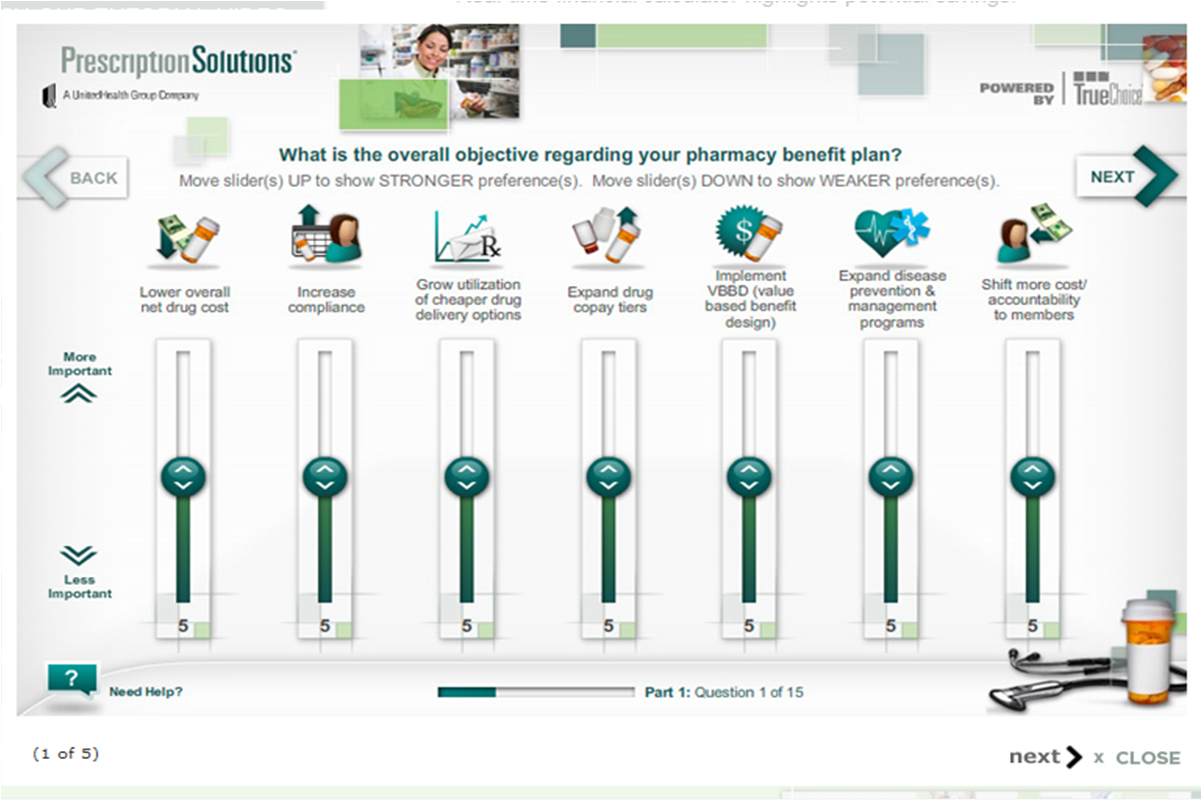
I don’t do a whole lot in the PBM pricing world these days, but I remember some of the process and the underwriting steps.  That being said, I was really impressed with the new Prescription Solutions online Pharmacy Benefit Advisor Tool (go to http://mybenefitpreferences.com). 

You go through a few basic steps to get an idea of how much you (payer) could save (with a very nice GUI). 

  1. Rank the features that matter to you – net cost, compliance, shifting cost to the consumer
  2. Rank the importance of different clinical programs
  3. Make some trade-offs in programs (A is more important than B)
  4. Enter some baseline data

Now, in reality, PBM pricing is never that simple, but what it effectively does is help articulate the savings that different decisions can create in a real-time setting.  It also forces some dialogue around issues – adhererence versus drug cost…which matters more to you?

I also think it could be a great way to help consumers understand the costs and savings associated with certain decisions.  I would also guess that the sales team at Prescription Solutions will find it helpful especially in the smaller, self-funded world.

The Express Scripts 2010 Drug Trend Report – Waste and Intent Focused

As I’ve talked about in the past, after working on the Express Scripts Drug Trend Report (recent copy here), I really enjoy getting the chance to read through them every year (see 2009 review or 2008 review). Over time, they’ve become less about the clinical side of the business and more about the programs used to engage the consumer with consolidated class specific data still included.

This year’s report is similar, but it is built around a new study that Express Scripts just completed with Harris Interactive. It comes to a rather surprising but interesting conclusion –

We discovered that the majority of people want to engage in the same behaviors plan sponsors seek to promote, but these desires often remain dormant. That is, there is a persistent intent–behavior gap. The key is structuring interventions that close the gap between what patients already want and what they actually do.

What’s the key point here? The point is that this says that consumers really want to move to generics and move to mail order, but they don’t do it. Is it that simple? I’d love to think so. And, for generics and mail order, I’m more likely to believe that inertia is a large factor. BUT, as I’ve talked about before, adherence has lots of complicating dimensions.

They focus on the gap between the physician and the optimal outcomes. This is certainly a major factor, but beyond consumer intent, there are issues of health literacy and physician beliefs that have to be addressed. Regardless, the point is correct…how do we engage and motivate consumers to change behavior especially if they are pre-disposed to change (when presented with the right facts).

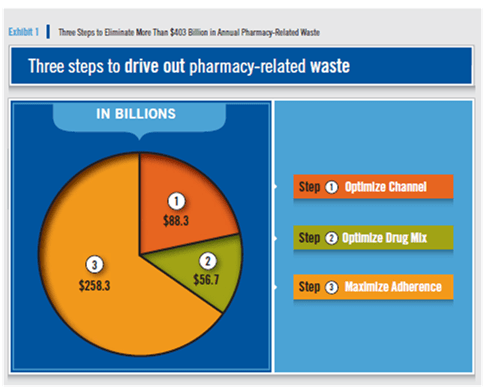
They did continue to build on last year’s focus on WASTE. They estimate that the waste in 2010 was over $403B as broken down below:

As adherence is a key issue here, they highlight the difference in adherence rates between retail pharmacy and mail pharmacy.

The focus of the report and the early press I’ve seen has been on the following chart. What it shows is some of the data from the Harris study saying that 82% of people would chose a generic (that are on a brand) and (depending on copay savings) 55-71% would chose retail.

One topic that I was glad was in the survey was limited networks. This is a topic everyone’s talking about from ReStat to Wal-Mart to Walgreens to CVS. Here’s what the research said with some explanation for what it means:

Of note is that about 40% said they would be willing to switch retail pharmacies to save their plan (or employer, or country) money. This fi gure is not as low as it fi rst appears because before a plan implements a more narrow retail network, a large fraction of members already use these pharmacies and therefore don’t have to switch pharmacies. It is not unusual, for example, for a client using a broad network to have 70% of prescriptions processed through pharmacies that are in the narrow network; members currently using these pharmacies do not have to make any changes. When a narrow network is implemented, if 40% of the users of the remaining 30% of prescriptions would willingly move to a lower-cost network pharmacy (as suggested by the survey), we estimate that the resulting overall market share within the narrow network would rise to 82% {70 % + (30% x 40%)}. (page 14 of the DTR)

All of this tees up their family of “Select” offerings (see Consumerology page) which builds on the success of Select Home Delivery and applies the concept of “Choice Architecture” from the book Nudge.

They talk about some of their work with adherence and their Adherence IndexSM. This metric is certainly one that has the industry’s attention as people wonder about the predictive value, how this is used, and how to craft solutions around such an index. My perception has been looking at studies like this one by Shrank and colleagues that past behavior remains the best predictor of future behavior, but I’m happy to be wrong.

So…what were the trend numbers?

  • 1.4% in the traditional (non-specialty drugs)
  • 19.6% in specialty
  • 3.6% overall

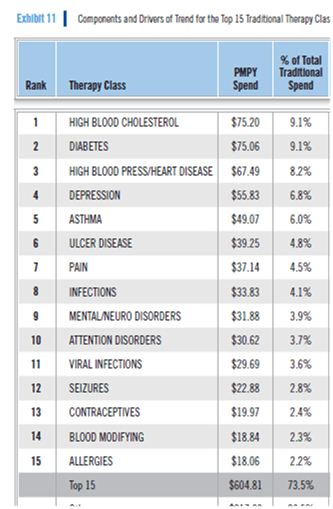
One of the other lists that I always find helpful to have is what are the top 15 drug classes and the PMPY spend.

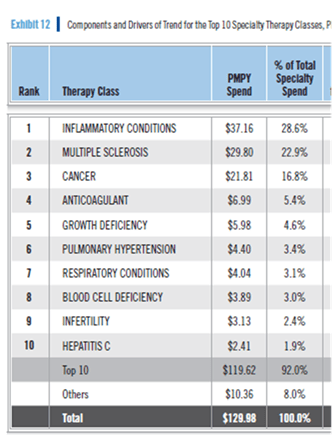
Of course, in today’s world, you really want to know this for specialty medications:

So, as always, I would recommend you read the report. Lots of great information in here. Interesting research. Good thoughts on consumer behavior and how to change it.

I think this week is their Outcomes conference which was always a good event.

Increasing Specialty Drug Refill Rates

Adherence is one of the primary topics of discussion today both within pharmacy and (after reform) within other areas of healthcare.  Adherence drives costs.  Adherence impacts productivity.  And, with a few rare exceptions (CBO type budget analysis looking only at fiscal year returns), everyone’s interests are aligned on the value of improving adherence.

For now, let’s skip over the traditional pharmacy market which is rapidly becoming generic. Let’s look at specialty where the average cost is $1,800 per month and can run into the $10,000’s.

So, what if I told you there were simple solutions that could improve your monthly refill rate on your drugs by 20-40%?  What if that also reduced the gaps-in-care and improved patient awareness of their condition?  What if that also incorporated a feedback mechanism to the care team?

How much would that we worth?  What about all that for $2 / month per member?  Much less that copay waivers or many other solutions out there on the market.

Sound interesting…Go learn more at Silverlink.